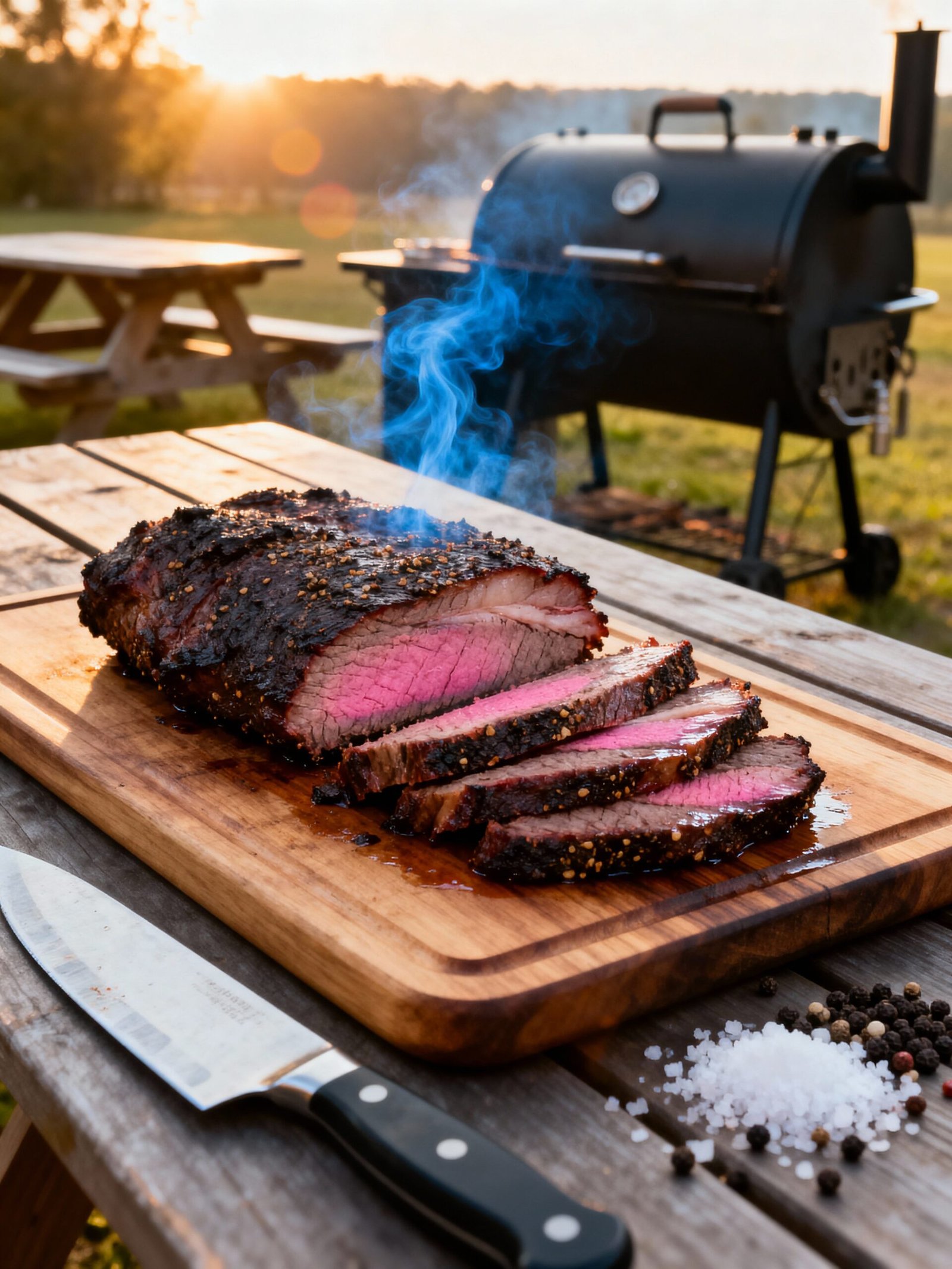
Ingredients
Equipment
Method
- Trim: Chill the brisket; trim fat cap to ~1/4 in (6 mm); remove hard, waxy fat and ragged edges; round corners; lightly score the fat cap.
- Dry brine: Salt all sides at 1.25–1.5% of trimmed weight; set on a rack, uncovered in the fridge for 12–24 hours.
- Preheat smoker: Stabilize at 245–255°F (118–124°C); add a water pan; aim for thin blue smoke.
- Season & load: Light binder; apply rub evenly; place brisket with fat toward the heat source (offset: fat down, point toward firebox; kettle/ceramic: fat down).
- Smoke phase: Cook at 250°F/121°C; once color sets (about 2.5–3 hours), spritz every 45–60 minutes to keep the surface tacky, not wet.
- Wrap when bark sets: At 165–175°F (74–79°C) internal AND when the bark doesn’t rub off, wrap tightly (butcher paper = crisper bark; foil = faster finish).
- Finish to probe‑tender: Continue at 250°F/121°C until the thickest part of the flat probes like warm butter (usually 200–205°F / 93–96°C). Feel beats numbers.
- Rest: Vent 5 minutes; rewrap; rest 1–3 hours in a dry cooler with towels or a 150–165°F (65–74°C) oven until internal drifts into the 150s°F (~65°C).
- Slice & serve: Separate point from flat; slice flat across the grain ~1/4 in (6 mm); slice point ~3/8 in (10 mm); brush slices with warm tallow or au jus if desired.
Notes
Time ranges: Cook usually 10–14 h at 250°F/121°C; rest 1–3 h.
Salt‑by‑weight: 1.25–1.5% kosher salt of trimmed meat weight (e.g., 80–95 g for a 14 lb brisket).
Wood: Post oak (balanced); hickory (stronger); mesquite (bold, sparingly); apple/cherry/peach (mild).
Spritz: 50/50 apple cider vinegar + water, or 50/50 beef stock + water.
Wrap: Paper = crisper bark; foil = faster finish (softer bark).
Troubleshooting: Dry flat—slice thinner and brush with warm tallow/au jus. Tight at 203°F—wrap and hold at 150–165°F for 30–60 min. Pale bark—run 10–15°F hotter next time and spritz later.
Storage: Fridge 3–4 days; freeze up to 3 months (slice first). Reheat sealed in 275°F/135°C oven 20–30 min or in a 150–165°F/65–74°C water bath.
Safety: USDA beef roasts minimum 145°F/63°C + 3‑min rest; brisket is typically cooked to 200–205°F (93–96°C) for tenderness.
Salt‑by‑weight: 1.25–1.5% kosher salt of trimmed meat weight (e.g., 80–95 g for a 14 lb brisket).
Wood: Post oak (balanced); hickory (stronger); mesquite (bold, sparingly); apple/cherry/peach (mild).
Spritz: 50/50 apple cider vinegar + water, or 50/50 beef stock + water.
Wrap: Paper = crisper bark; foil = faster finish (softer bark).
Troubleshooting: Dry flat—slice thinner and brush with warm tallow/au jus. Tight at 203°F—wrap and hold at 150–165°F for 30–60 min. Pale bark—run 10–15°F hotter next time and spritz later.
Storage: Fridge 3–4 days; freeze up to 3 months (slice first). Reheat sealed in 275°F/135°C oven 20–30 min or in a 150–165°F/65–74°C water bath.
Safety: USDA beef roasts minimum 145°F/63°C + 3‑min rest; brisket is typically cooked to 200–205°F (93–96°C) for tenderness.
